Rare Australian Coins Value: What Makes Them Skyrocket?
The rare Australian coins value forms under the influence of three strictly defined factors: mintage, preservation, and the presence of production deviations.
Scarcity of supply, conditioned by historical events or technical failures at mints, creates a basis for long-term price growth.
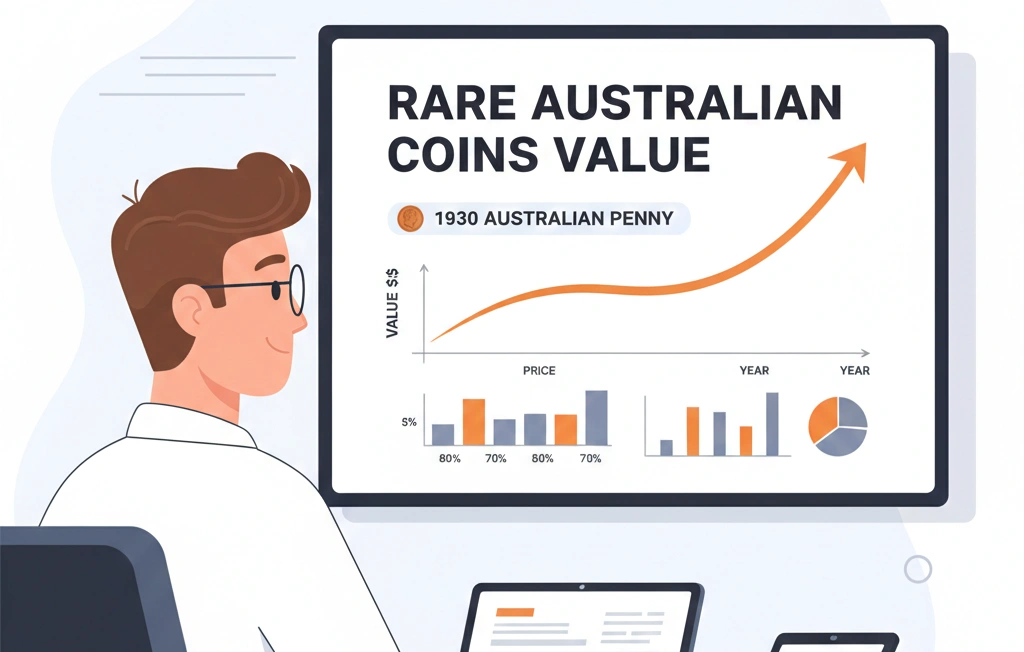
The Australian monetary system, including the pre-decimal (until 1966) and decimal periods, provides various asset categories for analysis.
The number of issued specimens serves as the primary indicator of potential value.
Coins having a mintage of fewer than 100,000 units for mass circulation automatically move into the scarce category.
Denomination and Year | Mintage | Nominal Value | Current Market Price (AUD) |
1932 2 Shillings | 188,000 | 0.20 AUD | 6,500 – 12,000 |
1933 1 Shilling | 200,000 | 0.10 AUD | 3,500 – 5,500 |
1923 3 Pence | 632,000 | 0.025 AUD | 2,500 – 8,000 |
The Influence of Minting Errors
Technical failures during the automated production process create unique objects possessing anomalous value.
Errors arising from the use of incorrect dies (Mules) are valued higher than standard defects.
In 2000, an obverse die from a 10-cent coin was mistakenly applied during the striking of a 1-dollar coin.
This error led to the creation of a "mule" with a double rim, whose price today exceeds the face value by 2,000 times.
Error Types and Their Impact on Capitalization
Mule: Using mismatched dies; value growth ranges from 10,000% to 50,000%.
Double Strike: Repeated impact of the die on the planchet; the premium varies from 500 to 1,500 AUD.
Broadstruck: Minting outside the retaining collar; the price increases by 150 – 400 AUD.
Grading and the Sheldon Scale
The surface condition of a coin, determined by a 70-point system, remains a decisive factor in major transactions.
A one-point difference in the higher range (MS67 versus MS68) can lead to a price change of 200–300%.
Professional certification carried out by companies such as PCGS or NGC excludes the possibility of subjective assessment.
Grade | Condition | Average Price (AUD) | Percentage Difference |
VG | Heavy wear | 18,000 | Base |
VF | Moderate wear | 35,000 | +94% |
EF | Minimal wear | 65,000 | +85% compared to VF |
UNC | No wear | 150,000+ | +130% compared to EF |
Asset Return Dynamics
Analysis of the returns on rare Australian coins worth money over the last 30 years shows a steady upward trend.
Unlike precious metals, numismatic rarities remain less susceptible to sharp market crashes.
The average annual price increase for top Australian rarities stands at 8.4%.
Period | Price Change (%) | Primary Driver |
2018 – 2019 | +6.2% | Increasing demand in the domestic market |
2020 – 2021 | +14.5% | Capital flow into alternative assets |
2022 – 2023 | +9.8% | Inflationary price adjustment |
2024 – 2025 | +7.4% (Forecast) | Supply deficit at auctions |
The 1813 Holey Dollar as a Value Benchmark
This artifact represents a Spanish dollar with a punched-out central part.
The rarity is conditioned by the limited number of surviving specimens, totaling approximately 300 units.
In 2015, a specimen in exceptional preservation set a record, reaching a price of 550,000 AUD.
The annual value growth of Holey Dollars remains stable at 5–7%, providing protection against inflation.
Modern Colored 2-Dollar Coins
A new market segment formed after 2012 demonstrates high rates of price growth.
Coins with colored coating, issued in limited mintages (from 500,000 to 2 million pcs), quickly disappear from circulation.
The absence of protective coatings on the enamel leads to rapid color degradation while kept in wallets.
Specimens preserved in ideal condition immediately after release appreciate by 2,000–5,000% over a decade.
Colored Coin Value Growth
2012 Red Poppy: Issue — 2 AUD, current price — 450 AUD (+22,400%).
2013 Purple Coronation: Issue — 2 AUD, current price — 150 AUD (+7,400%).
2015 Red Anzac Cove: Issue — 2 AUD, current price — 75 AUD (+3,650%).
Authenticity Indicators
Price growth provokes the appearance of high-quality counterfeits requiring the best coin value app verification.
Weight verification with an accuracy of 0.01 grams allows for filtering out most fakes manufactured from improper alloys.
For pre-decimal coins, the analysis of the edge and the detailing of the monarch’s crown is critically important.
The use of X-ray fluorescence analysis (XRF) confirms the metal's chemical composition matching the declared standard.
Market Outlook Forecast
The future of the Australian numismatic market depends on the digitization of registries and the transparency of auction deals.
The decline in the share of cash payments reduces the probability of accidentally discovering rare coins in circulation.
This process inevitably leads to a further reduction of supply on the secondary market.
The investment potential of 1930 pennies and colonial issues remains maximal due to the impossibility of increasing their physical quantity.
Conclusion
Rare Australian coins demonstrate market resilience surpassing traditional financial instruments.
Asset value grows proportionally to the decrease in available specimens in a high degree of preservation.
Technical errors and unique historical contexts create added value independent of metal exchange quotes.
A professional approach to storage and certification remains a mandatory condition for fixing profits in the long term.